REVIEW · VERONA
Dante in Verona: From Inferno to Paradise
Book on Viator →Operated by Slow Travel Italia · Bookable on Viator
Verona turns Dante into street-level reality. This 1 hour 30 minute walk threads Dante Alighieri through recognizable squares and quieter corners, so the Divine Comedy starts to feel like it happened right here. I especially like the clear story line from dark Inferno imagery to a calmer church finish, and I like how the itinerary keeps most entrances free.
One practical drawback: you’ll cover a lot of ground with short time windows at each stop, so if you want to linger, you may feel a bit rushed in the center. Still, with a small group limit of 15 and an English guide, it’s a smart way to fit Dante into a Verona day without committing to a longer tour.
In This Review
- Key things I’d bookmark before you go
- A 90-minute Dante walk that actually fits your Verona day
- Stradone S. Fermo to the Alighieri chapel: start where the story feels personal
- Piazza dei Signori: where politics, statues, and Inferno imagery meet
- Via Sottoriva and the view toward Torricelle: slow down on purpose
- Arche Scaligere: Gothic tombs, and why Cangrande mattered to Dante
- Duomo di Verona: finishing at Cattedrale di Santa Maria Matricolare
- Guide energy, pacing, and what you’ll notice once you’re walking
- Price and value: $42.05 for a guided Dante map
- Should you book this Dante in Verona walk?
- FAQ
- How long is the Dante in Verona walk?
- What does it cost?
- What language is the tour offered in?
- Where do I meet the guide and where does the tour end?
- Are there admission tickets included for the stops?
- How many people are in the group?
- Is a mobile ticket used?
- Is cancellation possible?
- Is the tour suitable for everyone, and can service animals attend?
Key things I’d bookmark before you go
- Dante’s Verona route connects poetry, politics, and real addresses in one smooth walking loop
- Mostly free entries at the key sights mean more time experiencing than budgeting
- Small group size (max 15) keeps the pace friendly and the questions possible
- Two “old Verona” streets and tombs give you atmosphere beyond the big square
- Ends in a calmer cathedral stop, which makes the Dante story feel like it resolves
A 90-minute Dante walk that actually fits your Verona day
This is a compact, guided experience priced at $42.05 per person for about 1 hour 30 minutes. That timing matters in Verona, where you’ll often want to keep room for an aperitivo, a separate self-guided walk, or the Arena area later. The group size stays small, up to 15 people, and you get English commentary with a mobile ticket.
What you’re really paying for here is context. Verona has famous sights, but Dante’s presence can be easy to miss if you only glance at street names. This tour builds a mental map: where Dante might have spent time, where political life played out, and how the city’s landmarks connect to his ideas in the Divine Comedy.
If you enjoy literature in a practical way, you’ll probably love this. It’s not a lecture hall. It’s a “look up, then listen, then look again” kind of stroll.
You can also read our reviews of more tours and experiences in Verona.
Stradone S. Fermo to the Alighieri chapel: start where the story feels personal
You meet at Stradone S. Fermo, 3 and begin your walk toward the earliest Dante-linked stops. The first highlight is a church connected to where Dante used to hang out, where there’s a chapel built by his family, the Alighieri. That’s a powerful opening because it shifts you away from generic sightseeing and into a more personal Dante frame: family, place, and memory in the same setting.
Right after, you’ll see another telling object in the city: a tower clock today, but originally a defensive tower meant to protect a noble family from rivals. It’s a quick stop, but it lands a big point. In medieval Verona, power wasn’t only in courts and books. It was in walls, towers, and who controlled the streets.
Possible drawback at the start: these older sites can be visually compact, so if you’re hoping for huge dramatic interiors every minute, your expectations should stay aligned with the tour length. Think “meaningful stops” more than “major attraction marathon.”
Piazza dei Signori: where politics, statues, and Inferno imagery meet

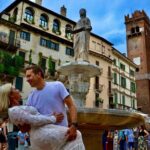
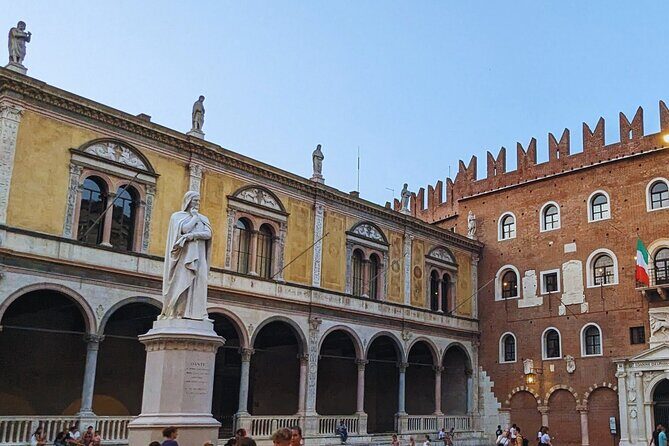
From there, the tour moves into Piazza dei Signori, a central ancient square where you’ll connect Dante’s life to the place itself. You’ll spend about 15 minutes here, and the guiding thread focuses on Dante Alighieri’s life in this setting, including his own statue.
What I like about this stop is that it’s not just a photo moment. The square is described as a cultural and political center, and that framing helps you understand why Dante’s world wasn’t only about spiritual ideas. His writing grew from civic conflict, alliances, rivalries, and the public life of a city.
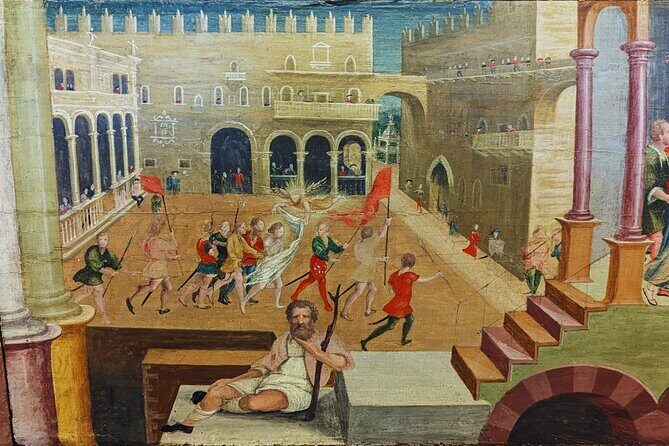
The tour also points out that this square has unique cultural spots linked to Inferno. Even if you know the story only in broad strokes, you’ll get a better sense of how physical spaces can echo literary themes. In other words, you start to read the city the way Dante wrote: with both literal and symbolic layers.
Tip for getting the most here: take a minute to scan the square before you listen. Once you’ve got the layout in your head, the guide’s connections land faster.
Via Sottoriva and the view toward Torricelle: slow down on purpose
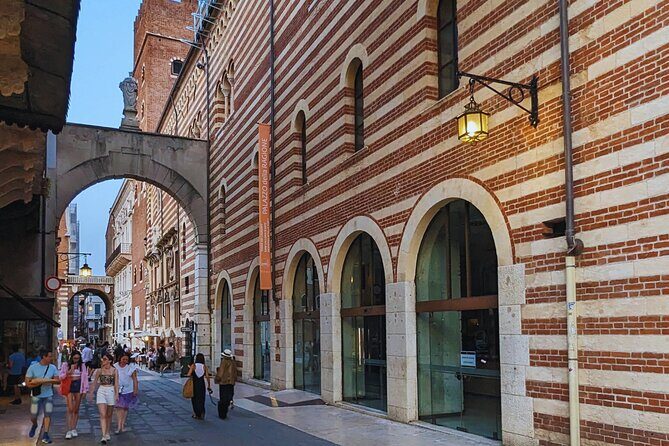
Next is Via Sottoriva, another 15-minute stop. This street is noted as one of the oldest in Verona and well preserved, and it gives you a small but important change of pace. Instead of monuments, you get street texture: aged stone, tight perspective, and the sense of walking inside the city’s older skin.
The view direction matters too. The street overlooks the hills of Torricelle, which gives you that rare combo in a walking tour: city walls and then a hint of countryside breathing space. Even without a big “lookout viewpoint,” you feel the geography.
If you’re the type who likes architecture and atmosphere, this is where the tour can feel most Verona. It’s also one of the best sections for anyone who wants a break from crowds. The street is simpler, and the mood shifts.
Short-time reality check: because it’s only about 15 minutes, you won’t have time to wander off. If you want to linger, you can always extend your walk afterward once the tour ends.
Arche Scaligere: Gothic tombs, and why Cangrande mattered to Dante
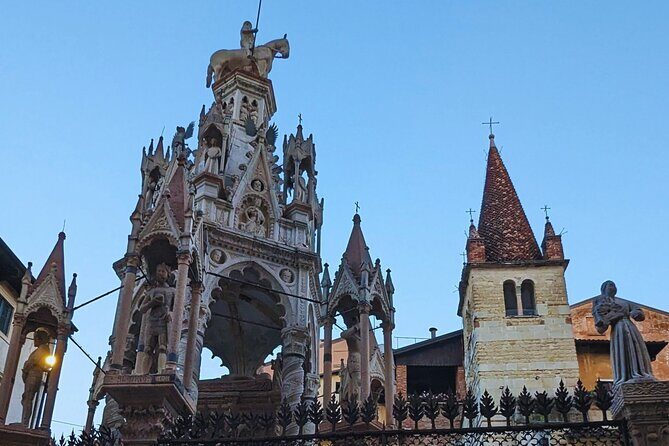
Then you hit Arche Scaligere, again around 15 minutes. These are elaborate Gothic tombs, including the resting place of Cangrande I della Scala—a powerful figure Dante admired and referenced in the Divine Comedy.
This stop is a good reminder that Dante wasn’t writing in a vacuum. Political admiration and literary reference lived side by side. The architecture does some heavy lifting here: the tombs aren’t treated as cold monuments, but as proof of how public power and personal inspiration can intertwine.
Why this works for first-timers: you get a concrete name—Cangrande I della Scala—then you connect it to a literary thread you can recognize. Once that connection clicks, you’ll likely start spotting Dante references in other places later in your trip.
Small drawback: if Gothic details aren’t your thing, you may want the guide’s storytelling more than the visual complexity. On this tour, that’s likely fine since the tombs are used as a narrative anchor, not an art-history test.

Duomo di Verona: finishing at Cattedrale di Santa Maria Matricolare

The tour ends at Cattedrale di Santa Maria Matricolare, with a meeting point finish near Piazza Vescovado. This final stop is described as the place where you’ll find the peace of Paradise, and you’ll also hear that it’s a Romanesque church that feels off the beaten track.
This is a smart way to end. After stops connected to defense, politics, and literary Inferno cues, the tour closes with a quieter mood. Even if you don’t catch every architectural point, the shift in tone helps you feel the arc of the guide’s Dante storyline.
One more practical point: ending in a calmer religious space is also a chance to slow your pace and reset for the rest of your day. You’re not leaving the tour still “amped up” from constant highlights. You can step out, look around, and decide what to do next based on your energy.
Guide energy, pacing, and what you’ll notice once you’re walking
A standout theme from the experience is the storytelling style. In the feedback I’m seeing, guides such as Leonardo and Giovanni (and the shorter form Leo) are repeatedly credited with weaving Dante’s life into the Divine Comedy in a way that keeps people engaged. That matters because Dante can feel intimidating if you only meet him through book summaries.
Here’s what that good storytelling usually looks like in practice on a walking tour like this:
- the guide uses the location to explain the idea
- you get names and themes, not just generic admiration
- the pace stays manageable even when weather is warm
On hotter days, comfort matters. The experience reviews mention care in scorching heat, which is a clue that the tour leaders keep the group moving and help you stay comfortable.
What to bring: light layers, water, and comfortable shoes. You’re walking through older streets, so you’ll want traction and support.
Price and value: $42.05 for a guided Dante map
Let’s talk value plainly. At $42.05, you’re paying for:
- English guidance that connects places to Dante’s life and work
- a tight route with multiple stops you can’t easily connect on your own quickly
- a small group experience (max 15)
- and a structure that keeps entrances in the plan
A big value point: the stops in the route are listed as having free admission for the sights included (for the main listed segments). That means your money goes mostly toward the story, not toward ticket math.
Is it worth it if you’re already a deep Dante reader? If you love the Divine Comedy, you might still enjoy seeing how local sites support the references and get you thinking about how Verona fits the poem’s world. If you’re newer to Dante, this format helps you get started without needing background reading first.
In short: it’s a good spend if you want Verona with a literary lens and you like being walked through a concept step by step.
Should you book this Dante in Verona walk?
I think it’s a solid choice if you fall into one of these buckets:
- You want a 1.5-hour activity that adds meaning to Verona beyond the usual big landmarks.
- You like literature connected to real places, not just plaques and dates.
- You’re traveling with at least one person who enjoys Dante, even if they’re not a scholar.
Skip it or adjust expectations if:
- You hate walking and want long indoor stays.
- You want time to linger at every stop. This tour is built on short, focused segments.
If you can handle short stops and you want your Dante to feel local, this tour is one of the more efficient ways to do it.
FAQ
How long is the Dante in Verona walk?
It runs about 1 hour 30 minutes.
What does it cost?
The price is $42.05 per person.
What language is the tour offered in?
The tour is offered in English.
Where do I meet the guide and where does the tour end?
You start at Stradone S. Fermo, 3, 37121 Verona VR, Italy and the tour ends at Cattedrale di Santa Maria Matricolare in Piazza Vescovado, 37121 Verona VR, Italy.
Are there admission tickets included for the stops?
The listed stops are indicated as having admission free for the included segments.
How many people are in the group?
The tour has a maximum of 15 travelers.
Is a mobile ticket used?
Yes, the tour uses a mobile ticket.
Is cancellation possible?
Free cancellation is available up to 24 hours before the experience starts for a full refund.
Is the tour suitable for everyone, and can service animals attend?
Most travelers can participate, and service animals are allowed.